

Sovereign Nations. Different Laws. One Complicated Payments System.
Sovereign Nations. Different Laws. One Complicated Payments System. On Indigenous Peoples' Day, it's time to examine why tribal gaming, ...
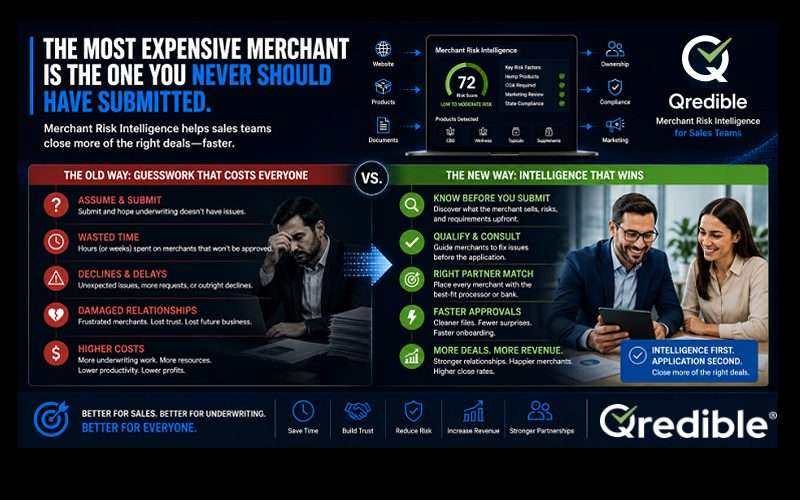
After more than 33 years in the payments industry, I've come to believe one of the biggest inefficiencies isn't found inside underwriting.

It's found long before an application ever reaches an underwriter.
Every day, sales agents, ISOs, merchant consultants, and business development teams spend countless hours pursuing opportunities that will never be approved.
Not because they're bad salespeople.
Not because the merchants aren't legitimate.
But because no one truly understands the merchant's risk profile before the sales process begins.
The result is a cycle we've all accepted as "part of the business."
It shouldn't be.
Think about the traditional merchant acquisition process.
A salesperson identifies a prospect.
Multiple conversations take place.
Pricing is negotiated.
Expectations are established.
An application is completed.
Documents are collected.
The merchant believes approval is imminent.
Then underwriting begins asking questions nobody anticipated.
Additional documentation.
Website changes.
Product removals.
Compliance issues.
Marketing violations.
Missing Certificates of Analysis.
State restrictions.
Policy conflicts.
Sometimes the merchant is approved.
Sometimes it takes weeks.
Sometimes the deal dies.
By then everyone has already invested significant time and resources.
When a merchant is declined after underwriting, the loss extends far beyond a single account.
The sales representative loses valuable selling time.
The ISO loses credibility with its processing partner.
The processor wastes underwriting resources.
The sponsor bank reviews a file that never should have reached them.
The merchant becomes frustrated.
Relationships suffer.
Future referrals disappear.
These costs rarely appear on financial statements.
But every executive knows they're real.
For decades, merchant sales has relied on experience.
"This looks like a good deal."
"I've boarded merchants like this before."
"I don't think underwriting will have a problem."
Those instincts matter.
But they're still assumptions.
Today's merchants operate far more complex businesses than they did even five years ago.
A restaurant may also sell THC beverages.
A wellness clinic may sell peptides online.
A beauty retailer may carry hemp-derived skincare.
A smoke shop may sell compliant hemp products alongside items prohibited by processor policy.
None of that is obvious from a business card, a website homepage, or an application.
Imagine beginning every merchant conversation with intelligence instead of assumptions.
Before an application is completed, the salesperson already knows:
Now the conversation changes.
Instead of saying:
| "Let's submit it and see what underwriting says." |
The salesperson says:
| "Here's exactly what we'll need to get you approved, and here's the processing partner that best aligns with your business." |
That's not just a better underwriting experience.
It's a better sales experience.
The highest-performing sales organizations don't simply sell payment processing.
They become trusted advisors.
Merchant Risk Intelligence allows sales professionals to consult rather than react.
Instead of waiting for underwriting to identify problems, they help merchants solve them before the application is submitted.
That creates enormous value.
For the merchant.
For the processor.
For the ISO.
For the sponsor bank.
Everyone starts the merchant onboarding process better prepared.
Every processor has different underwriting guidelines.
Different sponsor banks.
Different risk appetites.
Different prohibited products.
Different documentation requirements.
Submitting the same merchant to every processor hoping someone approves the account isn't a strategy.
It's expensive.
Merchant Risk Intelligence enables intelligent placement.
Sales teams can identify which acquiring partner best matches the merchant's products, services, and risk profile before the first application is submitted.
Approval rates improve.
Underwriting workloads decrease.
Partner confidence grows.
Merchants don't enjoy underwriting.
They don't understand why one processor asks for five documents while another asks for twenty.
They don't understand why they were declined after investing weeks into the process.
Most simply want clarity.
When sales teams arrive with intelligence instead of assumptions, merchants receive exactly that.
They know what needs to be fixed.
What documentation is required.
What products may create concern.
How long onboarding should take.
And what processor is most likely to approve their account.
That's a dramatically better customer experience.
One of the biggest misconceptions in payments is that underwriting begins when the application is submitted.
It doesn't.
The best underwriting starts before the first conversation.
It starts with understanding the merchant.
Their business.
Their products.
Their marketing.
Their risk.
Their opportunities.
By the time an application reaches underwriting, the surprises should already be gone.
This is one of the driving reasons we built Qredible.
We wanted to eliminate unnecessary friction between sales, underwriting, compliance, and merchants.
Through Q-Scan and Merchant Risk Intelligence, sales teams can pre-vet merchants before applications are submitted, identify compliance gaps early, recommend the right processing partner, and help merchants remediate issues before they ever become underwriting exceptions.
The result is a fundamentally different merchant onboarding experience.
Sales closes more qualified opportunities.
ISOs strengthen processor relationships.
Underwriters focus on real exceptions instead of preventable issues.
Processors activate merchants faster.
Sponsor banks receive cleaner, more complete files.
And merchants experience a consultative onboarding process instead of a frustrating guessing game.
For years, the payments industry has focused on making underwriting faster.
The next evolution is making sales smarter.
Merchant Risk Intelligence bridges the gap between sales and underwriting, replacing assumptions with evidence and reactive problem-solving with proactive consultation.
The organizations that adopt this approach won't just reduce declines or accelerate approvals.
They'll build stronger partner relationships, improve merchant satisfaction, lower operational costs, and create a meaningful competitive advantage in a crowded market.
Because the most valuable merchant isn't simply the one that gets approved.
It's the one that was qualified correctly from the very beginning.
Qredible has developed the worlds-first Merchant Risk Intelligence tool for sales teams and merchants. To learn more please visit www.qredible.com
Qredible is redefining merchant underwriting through Merchant Risk Intelligence (MRI)—a product-first approach that continuously analyzes what businesses sell, how they market those products, and the evidence required to support compliant payment acceptance. By moving beyond static industry classifications, Qredible helps banks, payment processors, ISOs, and sponsor banks make faster, more informed, and more defensible underwriting decisions while reducing manual effort and strengthening ongoing portfolio oversight. Learn more about Qredible's product-first automated compliance management platform for regulated industries →

