The Future of Peptide Commerce: Where Science, Regulation, AI, and Financial Infrastructure Converge
The Future of Peptide Commerce: Where Science, Regulation, AI, and Financial Infrastructure Converge The Peptide Economy — Part 6 of 6...
 The peptide industry is growing rapidly, and the commercial opportunity is attracting pharmaceutical companies, telehealth providers, compounding pharmacies, medical clinics, research laboratories, ecommerce entrepreneurs, and investors.
But there is a fundamental problem.
Many businesses entering the peptide market understand the demand for their products better than they understand the legal requirements governing their sale.
And in an industry where a product can be an approved prescription medication, an investigational drug, a compounded preparation, or a legitimate laboratory reagent, that distinction is everything.
In Part 1 of The Peptide Economy, we explored the science, the major categories of peptides, their therapeutic potential, and the changing regulatory environment.
Now we're following the money—and, more importantly, the products.
How does a peptide legally reach a patient?
What makes a telehealth business legitimate?
When can a research-use-only peptide be sold?
What role do pharmacies, manufacturers, and certification organizations play?
And what does a peptide business need to do today to create a sustainable future?
Let's follow the commercial journey.
Here's the most important thing to understand about this industry:
There is no single legal business model for selling peptides in the United States.
The applicable requirements depend on the specific product, its intended use, its regulatory status, and how it is manufactured, marketed, distributed, and sold.
Consider three businesses.
Business A sells FDA-approved prescription peptide medications through a properly licensed pharmacy.
Business B provides legitimate peptide materials to research laboratories for analytical and scientific work.
Business C sells unapproved injectable peptides directly to consumers, describing them as "research use only" while advertising their potential benefits for weight loss, recovery, or longevity.
All three sell peptides.
But they do not have the same legal standing.
The first may operate within the regulated pharmaceutical distribution system.
The second may operate as a legitimate research supplier, subject to the applicable requirements for its products and activities.
The third may be marketing unapproved drugs, regardless of what its website disclaimer says.
The critical question isn't whether a business sells peptides. It's whether that specific business is legally authorized to conduct that specific commercial activity.
For banks and payment processors, this is why an industry label alone is insufficient.
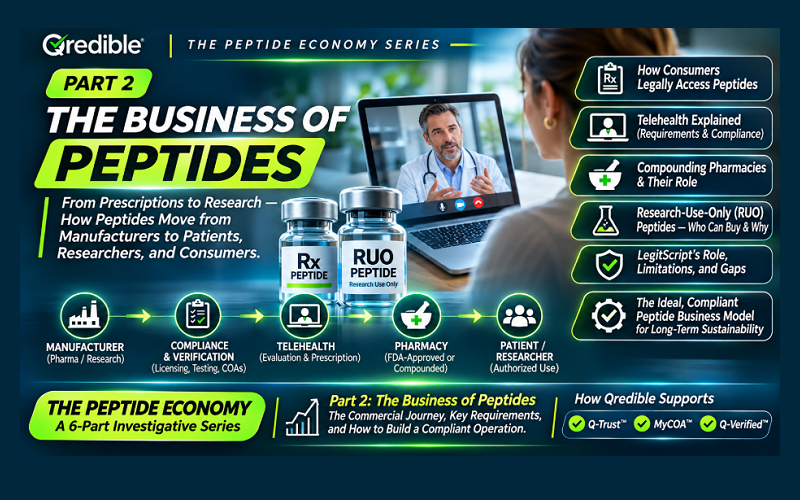
Let's begin with the most established pathway: FDA-approved prescription medications.
For drugs such as semaglutide or tirzepatide, the conventional patient journey follows a regulated process.
Step 1: Clinical Evaluation
A patient consults a licensed healthcare professional who evaluates their medical history, condition, potential contraindications, and treatment options.
This may occur in person or through an appropriately conducted telehealth consultation.
Step 2: Medical Decision & Prescription
If the clinician determines that a prescription medication is appropriate, an authorized prescriber issues a valid prescription.
The prescription must comply with applicable federal and state requirements.
A prescription is not simply an administrative formality. It must result from an appropriate professional evaluation.
Step 3: Licensed Pharmacy Fulfillment
The prescription is transmitted to an appropriately licensed pharmacy.
The pharmacy performs its required review and dispenses the medication according to applicable law.
Step 4: Patient Access
The patient receives the medication with appropriate labeling, instructions, and any required counseling or safety information.
Step 5: Ongoing Clinical Care
The healthcare provider monitors treatment, evaluates outcomes, and makes clinically appropriate adjustments.
This is a legitimate commercial pathway for prescription peptide medications.
But here's where many emerging businesses become confused.
The existence of an FDA-approved peptide does not mean every company can manufacture, repackage, compound, advertise, or sell its own version of that medication.
The product, source, prescription, pharmacy, and distribution model all matter.
Telehealth has transformed access to healthcare.
A patient can connect with a licensed clinician remotely, receive an appropriate evaluation, and, when medically indicated, obtain a prescription without necessarily visiting a traditional medical office.
For peptide-related treatment, this can create a convenient model for legitimate patient care.
But telehealth is not a shortcut around medical licensing or pharmaceutical regulation.
What Is Telehealth?
Telehealth refers broadly to healthcare services delivered using electronic communication technologies.
These may include video consultations, telephone interactions, remote monitoring, and certain asynchronous services.
The requirements vary by state, clinical service, professional discipline, and the technology used.
What Does a Legitimate Telehealth Business Need?
A sustainable telehealth operation should address several foundational requirements.
Appropriate clinical licensing: Clinicians generally must be authorized to practice in the jurisdiction where the patient is located, subject to applicable exceptions and interstate arrangements.
Professional clinical judgment: Medical decisions must be made by appropriately licensed professionals—not automatically dictated by a sales or marketing platform.
Valid prescribing practices: Prescriptions must satisfy applicable federal and state requirements, including standards for establishing a practitioner-patient relationship and evaluating the patient.
Corporate practice and ownership rules: Some states restrict how non-clinicians may own, control, or influence medical practices.
Privacy and data security: Depending on the organization's role and operations, HIPAA and other federal or state privacy and security laws may apply.
Pharmacy relationships: Prescription fulfillment must occur through appropriately licensed and authorized pharmacies.
Advertising compliance: Marketing must not misrepresent product approval, clinical evidence, safety, or expected outcomes.
Patient protection: The business needs appropriate consent, documentation, complaint handling, clinical escalation, and continuity-of-care procedures.
The Telehealth Business Model
Many telehealth companies operate through combinations of technology platforms, medical practices, management services organizations, pharmacies, and fulfillment providers.
Those relationships must be structured carefully.
The company collecting a subscription fee may not be the same legal entity providing medical services or dispensing medications.
That distinction is important for regulators.
And it's extremely important for banks and payment processors.
A telehealth website can look like a single business while representing several distinct legal and operational relationships.
Underwriting needs to understand who is actually providing each service and receiving each payment.
Where Qredible Helps
Q-Trust™ Merchant Intelligence can help organize business identity, ownership, website, licensing, marketing, and operational information.
For financial institutions, this provides a clearer starting point for evaluating the different entities involved in a telehealth business.
It does not replace clinical credentialing, legal review, or verification of the actual medical services provided.
Compounding is another area generating significant confusion in the peptide market.
A compounded medication is created by combining, mixing, or altering ingredients to meet a particular medical need.
Compounding can serve an important role in patient care.
However, compounded medications are not FDA-approved, and compounding is subject to specific legal conditions.
Two important federal pathways are:
Section 503A: Generally addresses qualifying compounding by licensed pharmacists in state-licensed pharmacies or by licensed physicians, subject to statutory conditions.
Section 503B: Establishes requirements for registered outsourcing facilities that qualify for certain exemptions when they meet applicable conditions.
Neither pathway creates unlimited permission to manufacture or sell unapproved peptide drugs.
Restrictions can involve bulk drug substance eligibility, product quality, manufacturing practices, prescription requirements, and limitations on copying commercially available approved drugs.
The legal requirements also differ between the two pathways.
The success of GLP-1 medications created extraordinary demand.
It also created opportunities for businesses offering compounded versions of peptide-based therapies.
But a compounded product does not automatically become lawful simply because the original molecule is associated with an FDA-approved medication.
And investigational peptides cannot necessarily be compounded merely because a physician wants to prescribe them.
For example, the FDA has specifically warned that retatrutide and cagrilintide cannot be used in compounding under current federal law.
A prescription cannot independently legalize a product that is not eligible to be compounded or marketed through the proposed pathway.
For businesses and financial institutions, compounding requires verification of the specific product, pharmacy, sourcing arrangements, and applicable legal conditions.
This may be the most misunderstood segment of peptide commerce.
Search online and you'll find numerous websites offering products labeled:
"Research Use Only."
"Not for Human Consumption."
"For Laboratory Research Purposes Only."
Those statements can be appropriate for legitimate research materials.
But they are not magic words.
A research-use-only disclaimer does not override the actual intended use of a product.
The FDA can consider the entire commercial context when evaluating whether an article is being marketed as a drug.
That can include product descriptions, advertising claims, customer communications, dosage-related information, and other representations.
What Does Legitimate RUO Commerce Look Like?
A legitimate research supplier may sell peptide materials for scientific investigation, analytical testing, method development, or other lawful laboratory purposes.
Potential purchasers can include:
There is no universal federal rule that every peptide reagent may be sold only to those categories. The requirements depend on the substance, intended use, and applicable law.
However, a seller should be able to substantiate that its products are being marketed and distributed for legitimate research purposes.
What Should an RUO Supplier Verify?
A responsible research supplier should establish procedures for:
Customer identity: Who is purchasing the material?
Institutional affiliation: Is the buyer associated with a legitimate research organization or other appropriate research activity?
Intended use: What research or analytical purpose is being represented?
Product identity: What substance is being supplied, with what purity, specifications, and documentation?
Product claims: Does the website avoid promoting unapproved human therapeutic uses?
Sales practices: Do communications, fulfillment practices, and marketing align with the stated research purpose?
Applicable restrictions: Are there substance-specific, import/export, chemical, or other legal requirements?
These are risk-management measures, not a universal statutory licensing checklist for all RUO peptides.
Can RUO Peptides Be Sold Directly to Consumers?
This requires careful distinction.
There is no simple rule that every peptide sold to an individual is automatically unlawful.
But selling an unapproved peptide with evidence that it is intended for human therapeutic use can trigger FDA drug requirements, even when the seller labels it RUO.
For businesses selling injectable peptides through consumer-oriented websites, this is a particularly serious concern.
A website promoting recovery, weight loss, muscle growth, anti-aging, or other human health benefits may undermine its claimed research-only positioning.
The same may be true of surrounding representations or sales practices.
The substance, intended use, and actual conduct matter more than the disclaimer.
Where Qredible Helps
This is a strong use case for Product Intelligence™.
Qredible can help identify products, review publicly available descriptions and marketing claims, organize supporting evidence, and flag potentially inconsistent representations.
That gives the merchant and its financial partners a way to investigate potential problems before they become regulatory or banking events.
LegitScript plays an important role in the online healthcare and regulated commerce ecosystem.
Its certification and monitoring services are used by payment providers, advertising platforms, and other organizations evaluating certain healthcare-related businesses.
For eligible online pharmacies and telemedicine businesses, certification can provide independent evidence that specified requirements have been reviewed.
That can be valuable.
However, there are important distinctions between:
Those are related, but they are not identical functions.
Where Certification Has Limitations
A business may be appropriately licensed or certified and still introduce new products, change its marketing, alter fulfillment relationships, or engage in activities requiring additional review.
Certification scope, surveillance frequency, reporting obligations, and enforcement procedures matter.
So does the timing of any alleged violation.
A certification is evidence of a review against specific criteria. It is not a permanent guarantee that every future product or activity will remain lawful.
Recent reporting and FDA enforcement activity involving online peptide sellers underscore why this distinction deserves attention.
However, it would be inappropriate to conclude that a particular seller violated the law while holding an active LegitScript certification without verifying its certification status, the dates
involved, the products, and the applicable findings.
We will examine documented cases and the wider certification model in Part 3.
How Qredible Complements Certification
Qredible's role is not to dismiss the value of licensing, accreditation, or certification.
It is to help close the operational gap between a point-in-time assessment and the continuously changing merchant business.
Through Q-Trust, Q-Registered, and MyCOA, businesses and financial institutions can maintain more structured product information, supporting evidence, and monitoring workflows.
Certification establishes a level of assessed trust. Continuous intelligence helps institutions determine whether the facts supporting that trust have changed.
Whether a business intends to sell prescription peptide medications or legitimate research materials, long-term sustainability requires more than a functioning website and access to a payment
processor.
It requires an operating model that can withstand regulatory scrutiny.
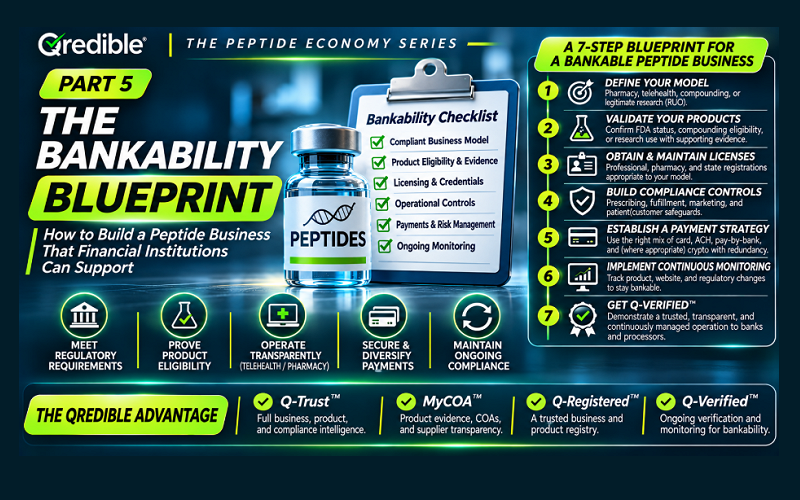
Step 1: Define the Business Model
Determine whether the organization will operate as a licensed pharmacy, telehealth platform, clinical practice, manufacturer, distributor, or research supplier.
Do not combine incompatible activities under an ambiguous business description.
Step 2: Validate Every Product
Create a complete product inventory.
For each product, document:
Step 3: Establish Licensing & Legal Authority
Determine the federal and state requirements applicable to the actual business model.
Obtain qualified legal and regulatory advice where necessary.
Step 4: Verify Suppliers and Manufacturing
Maintain appropriate supplier records, product specifications, quality evidence, and traceability.
For pharmaceuticals, confirm that the manufacturing and distribution pathways satisfy applicable requirements.
Step 5: Build Compliant Sales & Marketing
Ensure the website, advertisements, product descriptions, and customer communications reflect the lawful intended use of the products.
Step 6: Establish Customer or Patient Controls
For prescription commerce, use appropriate clinical evaluation, prescribing, and pharmacy fulfillment.
For legitimate research commerce, implement customer qualification and intended-use verification appropriate to the products and risks.
Step 7: Organize Documentation
Maintain accessible records supporting product identity, licensing, sourcing, quality, and other applicable obligations.
Step 8: Prepare for Banking & Payments
Understand that financial institutions may apply policies more restrictive than the minimum legal requirements.
Be prepared to explain the business model, product catalog, customer population, fulfillment, and compliance controls.
Step 9: Implement Continuous Monitoring
Reassess products, licenses, websites, marketing, and material operational changes.
Do not assume that initial approval establishes permanent eligibility.
Step 10: Demonstrate Accountability
Build processes that allow merchants, partners, and financial institutions to review current information, identify exceptions, and document corrective action.
The most sustainable peptide business is not necessarily the one with the largest product catalog. It's the one that can substantiate why its products and business practices are lawful and supportable.
The challenge facing peptide commerce is that business information is often fragmented.
Licenses exist in one system.
Product catalogs live on websites.
Laboratory reports are stored as PDFs.
Clinical and pharmacy relationships are documented separately.
Banking information sits in merchant underwriting files.
And changes occur continuously.
Qredible's Merchant Intelligence Operating System™ is designed to help connect these pieces into a more structured approach to regulated commerce.
Provides business, product, licensing, website, ownership, reputation, and related intelligence to support initial assessment and ongoing monitoring.
Helps associate product records with relevant laboratory evidence, quality documentation, and other supporting information where applicable.
A COA can support product identity or quality assessment, but does not itself establish FDA approval, lawful human use, or compliance with every regulatory requirement.
Provides a structured merchant a product registry to help maintain relevant information and make appropriate records accessible to authorized stakeholders.
Offers a credential reflecting defined verification criteria and ongoing monitoring expectations.
It is not a substitute for FDA approval, pharmacy accreditation, professional licensure, or a financial institution's independent underwriting decision.
Together, these capabilities help merchants organize information and give financial institutions better visibility into the businesses they support.
Consider a payment processor evaluating three prospective peptide merchants.
The first is a licensed pharmacy dispensing FDA-approved medications.
The second is a legitimate research supplier selling analytical materials to laboratories.
The third is a consumer-facing website promoting unapproved injectable peptides for therapeutic purposes.
All three may apply under descriptions such as "healthcare," "wellness," or "research supplies."
Yet their underlying legal and financial risks differ substantially.
If the processor relies only on the merchant's description, a business registration, and a static website review, it may miss important distinctions.
This can result in two equally problematic outcomes.
Legitimate businesses may be declined because the institution cannot adequately understand their activities.
And problematic businesses may be approved because their actual products and practices were not sufficiently investigated.
Better product intelligence helps financial institutions distinguish the businesses they can responsibly support from those requiring remediation, restrictions, or rejection.
That is the foundation of sustainable regulated commerce.
I believe peptide innovation has enormous potential.
But a promising scientific category does not automatically create a lawful commercial market for every product associated with it.
Prescription medications, compounded preparations, research reagents, and unapproved consumer drugs must be evaluated differently.
The businesses that succeed over the long term will be those that understand these distinctions and build their operations accordingly.
Regulatory readiness should not be something a merchant assembles only when a bank asks for it. It should be built into how the business operates.
And financial institutions need tools that help them evaluate that readiness based on actual products, practices, and evidence.
That's where Qredible believes Product Intelligence™ can make a meaningful difference.
Coming Next: Part 3 — The Peptide Certification Gap
Why a Certified Business Can Still Sell a Problematic Product
We'll examine the role of LegitScript, published enforcement cases, the distinction between certification and product-level verification, and why ongoing monitoring is becoming essential for banks and payment processors.
Connect With Qredible
If you're operating a peptide business, supporting telehealth or research commerce, or underwriting merchants in these categories, we'd welcome the opportunity to discuss how Q-Trust and MyCOA can help improve your intelligence, documentation, and compliance-readiness processes.
Know Before They Ask™.
Qredible | The Trust Layer for Regulated Commerce
Educational and regulatory notice: This article provides general industry information, not legal or medical advice. Product eligibility and business requirements depend on the specific facts, federal and state law, and applicable professional and financial institution requirements.
Qredible is redefining merchant underwriting through Merchant Risk Intelligence (MRI)—a product-first approach that continuously analyzes what businesses sell, how they market those products, and the evidence required to support compliant payment acceptance. By moving beyond static industry classifications, Qredible helps banks, payment processors, ISOs, and sponsor banks make faster, more informed, and more defensible underwriting decisions while reducing manual effort and strengthening ongoing portfolio oversight. Learn more about Qredible's product-first automated compliance management platform for regulated industries →