
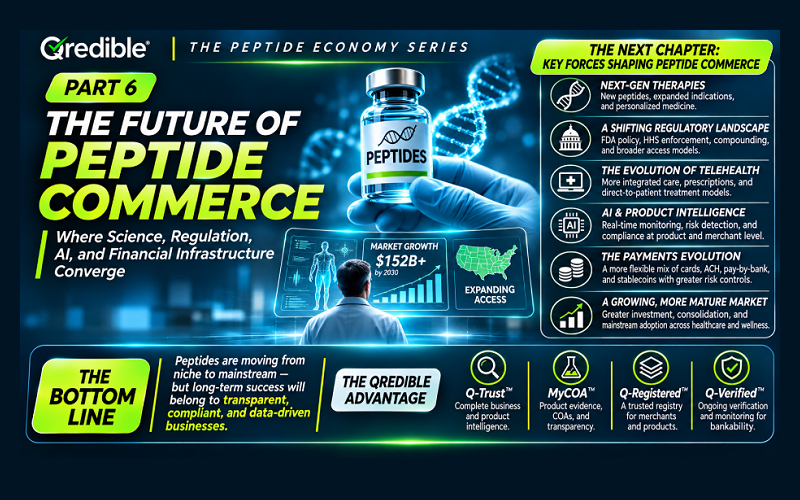
The Future of Peptide Commerce: Where Science, Regulation, AI, and Financial Infrastructure Converge
The Future of Peptide Commerce: Where Science, Regulation, AI, and Financial Infrastructure Converge The Peptide Economy — Part 6 of 6...
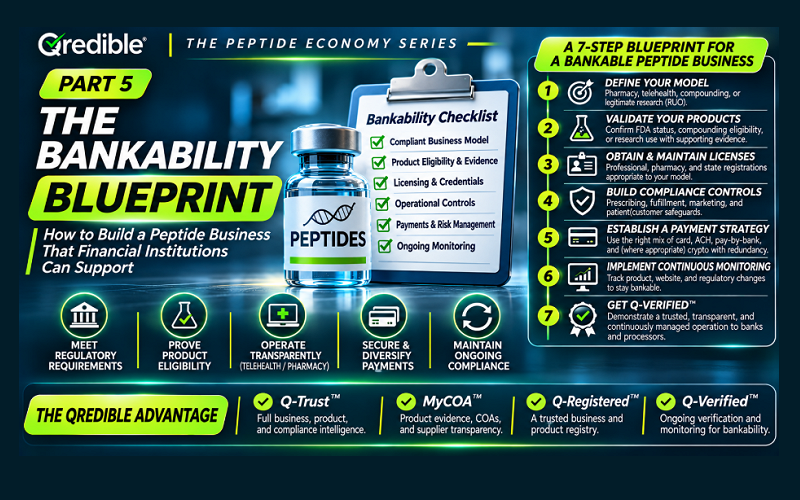
 Imagine two entrepreneurs launching peptide businesses.
Both have identified a growing market.
Both have invested in websites, suppliers, technology, and customer acquisition.
Both are ready to accept payments.
The first entrepreneur contacts a dozen payment processors, hoping to find someone willing to approve the business.
The second begins with a different question:
What do I need to build so that a responsible financial institution can confidently evaluate and support my business?
That single difference can determine the long-term sustainability of the operation.
After more than 30 years in the payments industry, I've seen countless businesses approach banking and payment processing backward.
They launch.
They begin selling.
They generate revenue.
And only then do they discover that their products, marketing practices, licensing, or operating model may not meet the requirements of the banks they need.
The result?
Rejected applications.
Unexpected reserves.
Frozen or delayed settlements.
Account terminations.
Lost customers.
And endless searches for another processor willing to take the business.
The problem isn't always that banks refuse to support an industry. Sometimes it's that businesses haven't built the transparency, controls, and documentation necessary to demonstrate that they deserve support.
For peptide businesses, this distinction is especially important.
In Parts 1 through 4 of The Peptide Economy, we examined the science behind peptides, commercial models, certification challenges, and payment infrastructure surrounding peptides.
Now we're bringing those lessons together into a practical blueprint.
How do you build a peptide business that is not merely capable of accepting payments today, but prepared to maintain sustainable banking relationships as regulations, products, and financial institution policies evolve?
Let's start by redefining a term that is often misunderstood.
Bankability is not simply finding a bank willing to approve your business.
It's the ability to demonstrate that your business model, products, operations, and risk controls satisfy the requirements of the financial institutions supporting you.
A bankable business should be able to answer five fundamental questions:
Who are you?
Can the institution verify the legal entity, ownership, management, and business operations?
What are you selling?
Can you provide a complete and accurate inventory of your products and services?
Are you authorized to sell it?
Can you substantiate the regulatory status, licensing, and legal basis for your activities?
How do you operate?
Can you demonstrate appropriate customer controls, marketing practices, fulfillment, financial management, and complaint handling?
How do you remain compliant?
Can you identify and address changes to products, regulations, licenses, and institutional policies?
These are not questions that should be answered only during underwriting.
They should be part of the way the business operates every day.
Bankability is an ongoing business discipline, not a one-time approval event.
The peptide market includes several very different commercial models.
A licensed pharmacy dispensing prescription medications.
A telehealth platform connecting patients with licensed clinicians.
A medical practice providing clinical services.
A compounding pharmacy operating under applicable federal and state requirements.
A biotechnology supplier providing peptide materials for legitimate research.
A pharmaceutical manufacturer developing or distributing regulated products.
Each has different obligations.
And those differences matter to acquiring banks.
The Questions Every Founder Should Answer
A telehealth company, for example, may operate through relationships among a technology platform, a medical practice, clinicians, and pharmacies.
A research supplier may need to establish that its products are marketed and distributed for legitimate scientific purposes rather than unapproved therapeutic use.
If you cannot clearly explain the business model, you should not expect an acquiring bank to approve it confidently.
Where Qredible Helps
Q-Trust™ Merchant Intelligence helps organize business identity, ownership, website, licensing, and operating-model information.
This can provide an early view of issues that should be investigated before approaching a financial institution.
This is perhaps the most important step in the entire blueprint.
A legitimate business can still create serious regulatory exposure by selling an ineligible product.
Consider the differences between:
These are not interchangeable categories.
A prescription does not automatically make an investigational substance lawful to compound.
A laboratory report does not establish FDA approval.
And a "research use only" disclaimer does not override evidence that a product is being marketed for human use.
Every peptide business should maintain a structured inventory containing, as applicable:
Product identity: Name, formulation, concentration, and relevant identifiers.
Regulatory classification: FDA-approved product, compounded preparation, investigational substance, research material, or another applicable category.
Intended use: How the product is represented, marketed, and distributed.
Manufacturer and supplier: The organizations responsible for production and sourcing.
Supporting evidence: Relevant product specifications, testing documentation, quality records, and regulatory information.
Distribution requirements: Prescribing, dispensing, customer qualification, and other applicable controls.
Marketing restrictions: Claims and representations that may affect regulatory classification.
Eligibility status: Whether the product is appropriate for the business model and the financial institution's requirements.
Qredible's MyCOA® Product Transparency Platform™ helps merchants organize product records and associate products with supporting laboratory evidence and documentation.
For peptide commerce, this creates a more structured approach to product identity, quality evidence, and verification.
A COA alone cannot establish whether a peptide is FDA-approved or lawful for human use.
But it can be an important part of a larger evidence-based assessment.
The goal is to know exactly what you're selling—and have the documentation to support it.
One of the most common mistakes in regulated commerce is assuming that a general business registration is sufficient.
It isn't.
A state business license may establish that a company is registered to operate.
It does not necessarily authorize the practice of medicine, pharmacy dispensing, pharmaceutical manufacturing, or other regulated activities.
Depending on the business model, relevant requirements may include:
The exact requirements depend on the activities, products, jurisdictions, and entities involved.
Don't simply collect licenses and store them in a folder.
Maintain a structured record of:
An expired license or an activity outside the scope of authorization can create a problem even when the rest of the business is operating appropriately.
Q-Trust's licensing intelligence capabilities can help identify relevant licensing information and support verification workflows.
Compliance cannot be the responsibility of one employee who responds to bank requests.
It needs to be embedded into how the business operates.
For Prescription & Telehealth Businesses
Controls may include appropriate clinical evaluation, valid prescribing, licensed pharmacy fulfillment, patient privacy, advertising compliance, and clearly defined relationships among participating entities.
For Legitimate Research Suppliers
Controls should address product identity, customer qualification appropriate to the materials and risks, intended-use representations, marketing practices, and relevant distribution requirements.
For All Peptide Businesses
Establish documented procedures for:
Supplier verification: Know where products originate and maintain appropriate sourcing evidence.
Product approval: Review new products before they appear on the website.
Marketing review: Evaluate product descriptions, advertising, and therapeutic claims before publication.
Customer and fulfillment controls: Apply the requirements appropriate to the business model.
Complaint management: Track customer concerns, refunds, disputes, and product-related complaints.
Change management: Document material changes to products, suppliers, business operations, and marketing.
Remediation: Assign responsibility for investigating and correcting identified issues.
The strongest compliance program is the one that identifies problems before a bank or regulator discovers them.
Now that the business model, products, and operations have been evaluated, it's time to prepare for banking and payments.
And this is where far too many merchants begin the process.
A sustainable approach starts here only after the earlier steps have been addressed.
A well-prepared application may include:
Business Documentation
Legal entity records, EIN, DBA information, ownership details, operating address, and relevant business registrations.
Licensing & Regulatory Documentation
Applicable professional licenses, pharmacy authorizations, registrations, and supporting regulatory information.
Product Documentation
A current product inventory, product classifications, relevant laboratory evidence, manufacturer information, and supporting compliance records.
Website & Marketing Review
Current URLs, terms and conditions, privacy policies, refund and fulfillment policies, product descriptions, and advertising representations.
Financial & Processing Information
Expected or historical monthly processing volume, average transaction amount, sales channels, processing statements, chargeback history, and financial information as requested.
Operational Controls
Information about suppliers, fulfillment, customer verification, recurring billing, clinical or research controls, and complaint management.
Risk & Remediation Summary
Known concerns, corrective actions, unresolved questions, and relevant supporting evidence.
This is where Q-Trust can deliver immediate value.
Before submitting an application, the merchant or its payment partner can initiate a Merchant Risk Intelligence assessment.
The report can help identify potential issues involving:
The merchant can then investigate and address identified issues.
Once corrections have been made, the MRI should be refreshed before submission.
That creates a stronger evidence-supported underwriting package.
The objective is not to guarantee approval.
It's to eliminate avoidable surprises and help the bank evaluate the business more efficiently.
As we discussed in Part 4, payment acceptance should never depend on a single assumption:
Someone will process my transactions.
A sustainable peptide business should evaluate payment options based on actual eligibility, customer experience, cost, and operational requirements.
Card Payments
Familiar to customers, but subject to acquiring bank underwriting, network requirements, chargeback controls, and potential reserves.
ACH
Useful for eligible recurring and bank-account-based payments, with its own authorization, return, and underwriting requirements.
Pay-by-Bank
An emerging option for eligible businesses seeking alternative payment experiences and potentially different transaction economics.
Cryptocurrency & Stablecoins
Potentially useful in certain lawful business models, but not a way to bypass financial regulation or product restrictions.
Build Genuine Redundancy
Where practical, establish more than one approved payment relationship.
Understand whether different processors rely on the same sponsor bank.
Maintain accurate disclosures across providers.
And ensure that every payment method supports the actual products and business activities.
Redundancy protects a legitimate business from provider concentration. It does not make an ineligible business bankable.
Here's where the long-term difference is created.
A merchant can complete every step we've discussed and still face problems six months later.
Why?
Because the business changes.
A new peptide is introduced.
A supplier changes.
A product formulation changes.
A license expires.
A marketing campaign introduces new claims.
A state changes its requirements.
A financial institution updates its risk appetite.
And suddenly, the merchant's original underwriting profile no longer reflects its current operations.
This is compliance drift—and it is one of the biggest threats to sustainable banking relationships.
What Should Be Monitored?
Products: New products, discontinued products, formulation changes, and supporting documentation.
Websites: Product descriptions, claims, policies, and other material content changes.
Licensing: Expirations, status changes, and relevant authorizations.
Business Operations: Material changes in ownership, suppliers, fulfillment, and service delivery.
Regulatory Requirements: Changes affecting products or commercial activities.
Bank Policies: Changes in the requirements of the financial institutions supporting the merchant.
The Qredible Approach
Q-Trust and MyCOA are designed to help maintain structured merchant and product intelligence and identify relevant changes for review.
When a potential issue is identified, the merchant and its financial partners can investigate, document corrective action, and update the relevant records.
The objective is to make compliance readiness a continuing process.
Not something the business scrambles to demonstrate after receiving a termination notice.
Now imagine the difference between two peptide merchants approaching the same acquiring bank.
Both operate in similar categories.
Both have comparable processing volumes.
But their readiness is very different.
Merchant A: Traditional Approach
The merchant has a website, a business license, and a collection of documents.
Product records are incomplete.
Compliance evidence is scattered.
The bank must request additional information repeatedly.
The merchant responds when problems arise.
Merchant B: Q-Verified Approach
The merchant maintains structured business and product records.
Relevant licenses and supporting documentation are organized.
Products are associated with available evidence.
Material changes are monitored.
Identified concerns are investigated and documented.
The merchant can demonstrate that it participates in a defined verification and monitoring program.
Which merchant is easier to evaluate?
Which gives the bank greater visibility?
Which is better prepared when policies change?
Q-Verified™ is designed to help merchants demonstrate this level of organization, transparency, and ongoing accountability.
It does not replace FDA approval, professional licensing, independent certification, or bank underwriting.
And it does not guarantee that a financial institution will approve or retain the merchant.
But it can provide evidence of a more disciplined operating model.
The goal is to make the merchant a relationship the bank can understand and monitor with greater confidence.
The opportunity extends beyond peptide merchants.
For ISOs, sales organizations, and payment processors, this blueprint represents a different approach to merchant acquisition and retention.
Instead of competing primarily on who can get a high-risk merchant approved, payment companies can help merchants become better prepared for underwriting.
Before the Sale
Use Merchant Risk Intelligence to understand the business and identify potential concerns.
During Discovery
Educate the merchant about product eligibility, licensing, and banking requirements.
Before Submission
Help the merchant organize documentation, address identified issues, and prepare a complete underwriting package.
After Approval
Support ongoing intelligence, monitoring, and remediation through Q-Trust and MyCOA.
When Requirements Change
Help the merchant evaluate the impact and respond proactively.
This changes the ISO's role from selling payment processing to supporting long-term merchant success.
And in regulated commerce, that is a much stronger value proposition.
Before a peptide business approaches a financial institution, it should be able to answer "Yes" to the following questions.
Business & Legal Structure
Product Eligibility
Licensing & Compliance
Banking & Payments
Continuous Monitoring
If the answers are incomplete, the business may not be ready for submission.
And discovering those gaps before underwriting is far less disruptive than discovering them after approval.
I believe the peptide industry has enormous potential.
But the businesses that survive and thrive won't necessarily be the ones with the most aggressive marketing, the largest catalogs, or the fastest customer acquisition.
They'll be the ones that build sustainable operations.
Businesses that know exactly what they're selling.
Businesses that understand the requirements governing their products.
Businesses that maintain accurate documentation.
Businesses that can demonstrate appropriate controls.
And businesses that respond to change before it becomes a crisis.
The same is true for the banks and processors supporting them.
The future of peptide commerce requires a better relationship between innovation and financial accountability.
That relationship begins with intelligence.
There will always be payment providers willing to advertise that they can support difficult merchant categories.
But the question every peptide entrepreneur should ask is not:
Who will approve me today?
It's:
What am I building that a responsible financial institution can support tomorrow, next year, and beyond?
Because payment processing approval is temporary if the business cannot sustain the conditions that made it eligible.
The real competitive advantage is not simply getting approved.
It's becoming a transparent, well-documented, continuously monitored business that financial institutions can evaluate with confidence.
That's the foundation of Qredible's approach to Merchant Intelligence™.
Coming Next: Part 6 — The Future of Peptide Commerce
Where Science, Regulation, AI, and Financial Infrastructure Converge
In our final installment, we'll examine how emerging therapies, evolving FDA policy, personalized medicine, telehealth, AI, and product intelligence may reshape the peptide economy.
And we'll explore what the next generation of regulated commerce infrastructure needs to look like.
Build Your Bankability With Qredible
If you're launching or operating a peptide business, supporting telehealth or legitimate research commerce, or underwriting merchants in these categories, connect with Qredible.
Explore how Q-Trust™, MyCOA®, Q-Registered™, and Q-Verified™ can help establish a more transparent, organized, and evidence-supported approach to merchant readiness.
Know Before They Ask™.
Qredible | The Trust Layer for Regulated Commerce
Educational notice: This article provides general information, not legal, medical, or financial advice. Regulatory requirements and payment eligibility depend on the specific products, business model, jurisdictions, and financial institution policies. Qredible's services support intelligence and verification workflows but do not guarantee compliance or bank approval.
Qredible is redefining merchant underwriting through Merchant Risk Intelligence (MRI)—a product-first approach that continuously analyzes what businesses sell, how they market those products, and the evidence required to support compliant payment acceptance. By moving beyond static industry classifications, Qredible helps banks, payment processors, ISOs, and sponsor banks make faster, more informed, and more defensible underwriting decisions while reducing manual effort and strengthening ongoing portfolio oversight. Learn more about Qredible's product-first automated compliance management platform for regulated industries →
