The Future of Peptide Commerce: Where Science, Regulation, AI, and Financial Infrastructure Converge
The Future of Peptide Commerce: Where Science, Regulation, AI, and Financial Infrastructure Converge The Peptide Economy — Part 6 of 6...
 Imagine a future where a new peptide therapy receives FDA approval.
Within months, healthcare providers begin prescribing it, pharmacies prepare to dispense it, telehealth platforms integrate it into their clinical offerings, and patients begin accessing treatment.
Behind the scenes, an entirely different ecosystem must respond.
Manufacturers must establish supply chains.
Pharmacies must validate their distribution requirements.
Healthcare providers must understand the appropriate prescribing conditions.
Banks must determine which businesses and transactions they can support.
Payment processors must evaluate merchant eligibility.
And regulators must oversee a rapidly evolving marketplace.
Now imagine that much of the information needed to support those decisions is fragmented across websites, regulatory databases, laboratory reports, spreadsheets, and disconnected underwriting systems.
That is largely the challenge facing regulated commerce today.
We are entering an era in which medical innovation is accelerating, but the infrastructure supporting commercial access has not always kept pace.
And peptides provide a fascinating example of what happens when science, regulation, technology, and financial services converge.
Over the past five installments of The Peptide Economy, we've explored the science behind peptides, the business models bringing them to market, the limitations of certification, the challenges of payment acceptance, and the blueprint for building a bankable business.
Now I want to look forward.
What will the peptide economy look like over the next five to ten years? And what must change for legitimate businesses to participate sustainably?
Peptide-based medicines are not new.
Insulin has been used in medicine for more than a century, and numerous peptide-based drugs are already part of modern healthcare.
What's changing is the scale of commercial interest and the range of potential applications.
The success of GLP-1-based treatments has demonstrated the enormous medical and economic potential of certain peptide therapies.
Pharmaceutical companies are investigating new molecules, delivery methods, and treatment combinations.
Research continues across metabolic disease, endocrinology, oncology, and other therapeutic areas.
At the same time, consumer interest in longevity, recovery, performance, and personalized health has created demand for products whose scientific and regulatory status varies considerably.
And that's where the opportunity and the risk intersect.
Scientific potential does not automatically translate into legal commercial availability.
Some peptides will progress through clinical development and receive regulatory approval.
Others may fail clinical trials or never establish an acceptable safety profile.
Some may remain useful laboratory research materials without becoming approved human medicines.
The future will not be defined by every peptide reaching consumers.
It will be defined by the ability to distinguish products with established legal pathways from those that remain investigational or unsuitable for commercial human use.
For financial institutions, that distinction will become increasingly important.
One of the most interesting developments in the peptide industry is the changing conversation around access, compounding, and regulatory oversight.
The current administration, including HHS Secretary Robert F. Kennedy Jr., has shown interest in revisiting certain restrictions affecting access to selected peptides.
The October 2026 HHS draft enforcement-discretion proposal concerning six peptide substances illustrates this direction.
But it also illustrates why businesses must be careful.
A policy proposal is not FDA approval. Enforcement discretion is not unrestricted commercialization.
The FDA's responsibility to evaluate drug safety, effectiveness, manufacturing quality, and lawful marketing does not disappear because policymakers are exploring alternative approaches.
And state medical and pharmacy requirements remain relevant.
I expect the debate to continue around several fundamental questions.
How should emerging therapies be evaluated?
What evidence should be required before broader access?
When is pharmaceutical compounding appropriate?
How should legitimate research materials be distinguished from unapproved drugs marketed to consumers?
And how can regulators protect patients without unnecessarily restricting legitimate scientific innovation?
These questions will shape the future of peptide commerce.
But here's the challenge for businesses and financial institutions:
Regulatory change creates opportunity only when organizations can identify how the change affects their specific products and activities.
A new policy may affect one peptide, formulation, intended use, or distribution pathway without changing the status of others.
That requires a much more precise understanding of products than traditional merchant classification provides.
Telehealth has already demonstrated that healthcare delivery does not always require a traditional office visit.
For appropriate clinical services, patients can consult licensed professionals remotely, receive treatment recommendations, and access prescription medications through legitimate pharmacy
relationships.
I believe these models will continue evolving.
But the next generation of telehealth will also face greater expectations for transparency.
Who is actually providing the medical services?
Which legal entity employs or contracts with the clinicians?
Where are the clinicians licensed?
Which pharmacy fulfills the prescription?
What products are being dispensed?
How are medical decisions made?
What information is being presented to patients?
And how are financial transactions allocated among the participating businesses?
These questions matter because telehealth is often more complex than a website suggests.
A single consumer-facing brand may represent multiple legal entities, professional relationships, and regulated activities.
For banks, understanding the website is not the same as understanding the business.
This is one area where Qredible's Business Intelligence™, Licensing Intelligence, and Product Intelligence™ can support a more complete assessment.
The goal is to help financial institutions understand the commercial structure behind the digital experience.
AI is already influencing how organizations approach scientific research, data analysis, and business operations.
In pharmaceutical research, computational methods can help scientists investigate molecular properties, prioritize candidates, and analyze complex datasets.
These technologies may improve portions of the discovery and development process.
But AI-generated predictions do not replace clinical evidence, manufacturing controls, or regulatory review.
The same principle applies to commerce.
AI can help identify potential risks.
It can analyze websites.
It can classify products.
It can recognize changes.
It can compare available information against defined policies.
But it cannot responsibly declare a business compliant merely because an algorithm assigns it a favorable score.
AI is most valuable when it makes evidence easier to collect, interpret, and act upon.
A financial institution has 2,000 merchants operating across healthcare, supplements, biotechnology, and research supply categories.
Each merchant maintains a changing website and product catalog.
Traditional periodic reviews may require substantial manual effort.
Now imagine a system capable of helping the institution:
That is a fundamentally different operating model.
Instead of asking risk analysts to repeatedly reconstruct merchant profiles, technology can help maintain a more current intelligence picture.
The future of merchant risk management is not more reports. It's better intelligence connected to operational decisions.
This is the direction of Qredible's Merchant Intelligence Operating System™.
Historically, financial institutions have largely evaluated merchants through business-level information.
Industry classifications.
Ownership records.
Financial statements.
Processing history.
Websites.
Licenses.
These remain essential.
But consider the limitations of treating every business in a broad category as though it presents the same risk.
A licensed pharmacy dispensing FDA-approved medications is not equivalent to an ecommerce seller promoting investigational injectable peptides for human use.
A biotechnology company supplying qualified research laboratories is not equivalent to a consumer-facing business using research disclaimers to market unapproved therapeutic products.
Yet all may describe themselves as peptide businesses.
The next evolution of merchant underwriting must connect business intelligence to product intelligence.
That means evaluating:
What is the product?
What is its regulatory status?
Who manufactures it?
What is its intended use?
How is it marketed?
Who is permitted to purchase it?
What evidence supports its identity and quality?
What jurisdictions and institutional policies apply?
And what happens when any of those factors change?
This shift has implications far beyond peptides.
The same framework is relevant to CBD, hemp, vape, nutraceuticals, pharmaceuticals, and other regulated product categories.
The future of risk management will increasingly depend on understanding what a merchant sells—not simply what industry the merchant claims to operate in.
Today, product information is often fragmented.
A merchant may maintain product descriptions in an ecommerce platform.
Laboratory reports may be stored in PDFs.
Supplier documentation may exist in separate systems.
Licensing information may be available through state databases.
Regulatory information may be scattered across federal and state resources.
And the acquiring bank may have only a limited snapshot of that information.
Imagine a different model.
Each product has a structured digital record.
The record identifies the product, relevant attributes, manufacturer, intended use, and supporting documentation.
Applicable regulatory considerations are associated with the record.
Changes are documented.
Potential compliance issues can be investigated.
Authorized financial partners can access current information relevant to their decisions.
That is the opportunity behind Qredible's MyCOA® Product Transparency Platform™ and Q-Registered™ product registry.
MyCOA helps organize product information and associated laboratory evidence.
Q-Registered provides a framework for structured merchant and product records.
Together with Q-Trust, these capabilities can support a more transparent relationship between the merchant and the financial institution.
But an important distinction remains:
A product record is not FDA approval.
A laboratory report is not authorization for human consumption.
And a verification credential is not a substitute for regulatory or bank review.
The value is in making relevant evidence accessible, current, and actionable.
The future of payments is about more than credit cards.
ACH, pay-by-bank, real-time payment infrastructure, embedded payments, digital assets, and stablecoins are expanding the ways businesses and consumers can exchange value.
For legitimate peptide businesses, greater payment flexibility may improve customer experience and reduce dependence on a single provider.
But I believe one principle will remain unchanged:
A new payment rail does not change the legal status of the underlying transaction.
An unapproved drug does not become lawful because a consumer pays with cryptocurrency.
A prohibited merchant activity does not become acceptable because the transaction moves over ACH instead of a card network.
And a stablecoin does not eliminate the need for appropriate due diligence.
The opportunity lies in connecting payment innovation with better merchant intelligence.
Imagine Intelligent Payment Eligibility
A legitimate peptide business offers multiple payment methods.
Its products and operating model have been evaluated.
The business understands which financial institutions and payment providers support its activities.
Relevant product and policy changes are monitored.
When a new product is introduced, its eligibility can be reviewed before the merchant begins accepting transactions for it.
When an institution changes its policy, the merchant can evaluate the potential impact.
And when a provider relationship changes, the merchant has a documented continuity strategy.
This is the direction payment infrastructure should be moving.
Not simply faster transactions. Smarter decisions about which transactions and businesses can be responsibly supported.
Throughout this series, I've returned to one concept repeatedly.
Bankability.
Not simply obtaining a merchant account.
Not simply securing a sponsor bank.
But building a business that can demonstrate why it remains eligible for financial services.
In the future, I believe successful regulated merchants will increasingly treat bankability as an operating discipline.
They will maintain structured product information.
They will verify relevant licenses.
They will review marketing claims.
They will document sourcing and fulfillment.
They will monitor changes.
They will maintain current evidence.
And they will be prepared to respond when regulations or bank policies evolve.
This is the philosophy behind Q-Verified™.
Q-Verified is designed to help businesses demonstrate that they participate in defined verification and monitoring processes.
It builds on the information and evidence maintained through Q-Trust, Q-Registered, and MyCOA.
The objective is to make a merchant's operating practices more transparent and easier for authorized partners to assess.
Q-Verified does not guarantee legal compliance or bank approval.
But it can help merchants demonstrate something that financial institutions increasingly need:
An organized, evidence-supported approach to managing a changing regulated business.
That is far more meaningful than treating underwriting as a paperwork exercise completed once at onboarding.
Now imagine bringing these capabilities together.
A pharmaceutical manufacturer introduces an FDA-approved peptide medication.
A licensed pharmacy adds it to its product catalog.
A telehealth provider incorporates it into an appropriate clinical offering.
The merchant's product records are updated.
Relevant licensing, sourcing, and product documentation are associated with the offering.
The acquiring bank has access to the information needed to assess the change under its policies.
The payment processor can evaluate continued eligibility.
And future material changes can be detected and reviewed.
This is not a claim that every system already operates in this manner.
It is a vision for how regulated commerce infrastructure could evolve.
One where information moves more efficiently among authorized participants.
One where merchants spend less time repeatedly assembling the same documentation.
One where banks gain better visibility into the businesses they support.
And one where regulators and other authorized stakeholders can obtain relevant, auditable evidence through appropriate channels.
The goal is not to eliminate oversight. It's to make oversight more informed, efficient, and responsive.
That's the opportunity we see for Qredible.
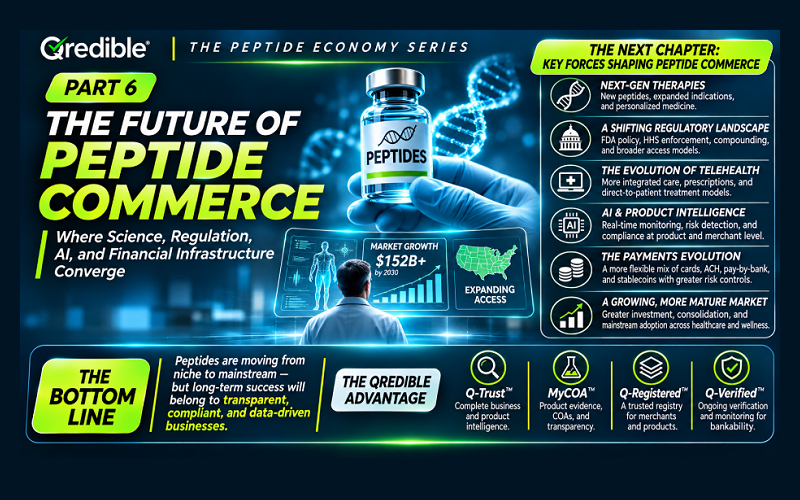
I believe several developments will shape the peptide economy.
Greater Pharmaceutical Innovation
Additional peptide-based therapies may emerge as research progresses, although clinical success and regulatory approval cannot be assumed.
More Sophisticated Telehealth Models
Digital healthcare businesses may become more integrated, with increased emphasis on clinical governance, pharmacy relationships, and transparent operating structures.
Greater Regulatory Scrutiny
As commercial interest grows, regulators may continue examining unapproved products, misleading marketing claims, inappropriate compounding, and unsafe distribution practices.
More Product-Level Underwriting
Financial institutions may increasingly require evidence about individual products and commercial activities rather than relying exclusively on broad merchant categories.
More Automated Monitoring
AI and structured data systems may help identify product changes, licensing issues, and other developments requiring investigation.
More Transparent Merchant Relationships
Businesses that maintain current records and demonstrate strong operational controls may be better positioned to engage with financial institutions that support their activities.
These are directional expectations, not guaranteed outcomes.
But the underlying need is clear.
As commerce becomes more complex, the systems responsible for evaluating it must become more intelligent.
To the entrepreneurs:
Are you building a business that can survive regulatory and banking scrutiny, or simply one that can generate sales today?
To the telehealth providers:
Can you clearly demonstrate the relationships, licenses, products, and controls behind your consumer-facing platform?
To the research suppliers:
Can you substantiate the intended use of your products and the legitimacy of your commercial practices?
To the ISOs and payment companies:
Are you helping merchants become more bankable, or simply moving applications from one processor to another?
To the acquiring banks:
Can you distinguish legitimate operators from businesses presenting unacceptable risk without excluding an entire emerging industry?
And to the technology companies:
Are you creating more dashboards and reports, or are you helping organizations make better decisions with verifiable evidence?
The future of peptide commerce will depend on how well we answer these questions.
Over this six-part series, we've explored a market filled with both extraordinary potential and significant complexity.
We've examined the science.
The regulatory landscape.
Prescription and research commerce.
Telehealth.
Certification.
Banking.
Payments.
And the operating practices required for long-term sustainability.
My conclusion is simple.
The peptide economy doesn't need fewer rules or more payment processors willing to look the other way. It needs a better infrastructure for distinguishing legitimate commerce from unacceptable risk.
That requires transparency.
It requires evidence.
It requires continuous monitoring.
And it requires financial institutions to understand the products and businesses they're being asked to support.
I believe that when these capabilities come together, legitimate innovation has a better opportunity to reach the market responsibly.
And banks and payment processors have a stronger foundation for supporting it.
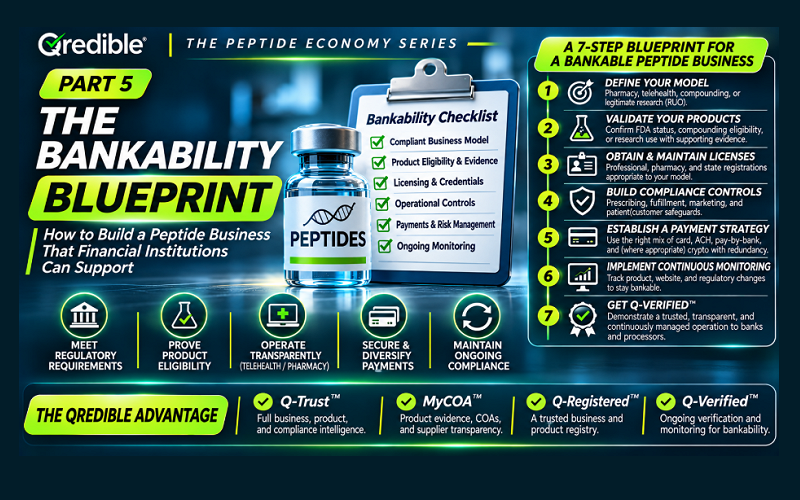
At Qredible, we're building toward that future through our Merchant Intelligence Operating System™, Product Intelligence™, Q-Trust™, MyCOA™, Q-Registered™, and Q-Verified™.
Not simply to help businesses get approved.
But to help create a more transparent, accountable, and sustainable model for regulated commerce.
Because the next great breakthrough in peptide commerce may not be another peptide.
It may be the intelligence infrastructure that finally allows legitimate innovation, financial access, and regulatory accountability to work together.
Thank you for following this six-part exploration of one of the most fascinating and consequential emerging areas of regulated commerce.
Our objective has been to help business owners, financial institutions, and payment professionals better understand the opportunities, responsibilities, and risks associated with this market.
The conversation doesn't end here.
As peptide science, regulatory policy, and financial technology continue evolving, so will the questions surrounding legitimate access and sustainable commerce.
Join Qredible in Building the Future of Regulated Commerce
If you're an acquiring bank, payment processor, ISO, telehealth provider, pharmacy, biotechnology business, or legitimate research supplier, we'd welcome the opportunity to explore how Qredible can support your organization.
For financial institutions: Gain deeper merchant and product intelligence, strengthen underwriting, and improve visibility into material changes across regulated portfolios.
For payment companies and ISOs: Help merchants improve readiness, identify potential issues before submission, and build more sustainable relationships.
For peptide businesses: Organize your products, licensing, and supporting evidence while establishing a more proactive approach to banking and compliance readiness.
The future of commerce belongs to those who can demonstrate trust—not simply claim it.
Know Before They Ask™.
Qredible | The Trust Layer for Regulated Commerce
Educational notice: This article discusses regulatory and industry developments and presents forward-looking opinions. It does not constitute legal, medical, investment, or financial advice. Product eligibility, regulatory requirements, and payment acceptance depend on the specific circumstances and applicable law. Qredible supports intelligence, evidence management, and monitoring workflows; it does not guarantee regulatory compliance or financial institution approval.
Qredible is redefining merchant underwriting through Merchant Risk Intelligence (MRI)—a product-first approach that continuously analyzes what businesses sell, how they market those products, and the evidence required to support compliant payment acceptance. By moving beyond static industry classifications, Qredible helps banks, payment processors, ISOs, and sponsor banks make faster, more informed, and more defensible underwriting decisions while reducing manual effort and strengthening ongoing portfolio oversight. Learn more about Qredible's product-first automated compliance management platform for regulated industries →