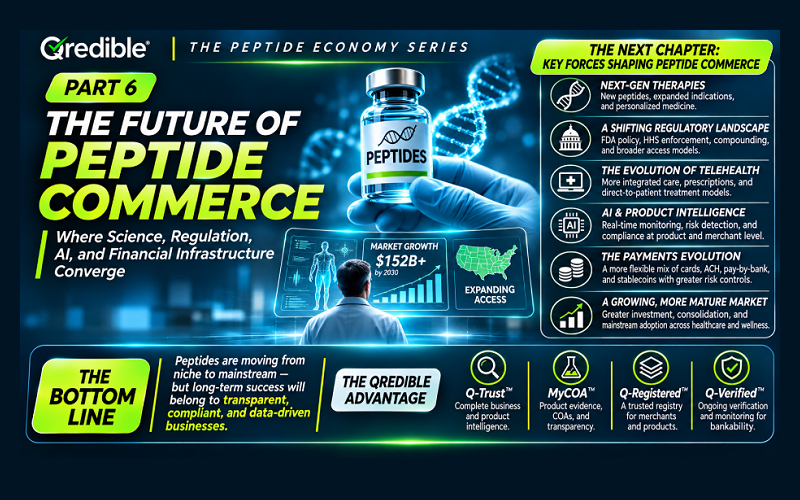
The Future of Peptide Commerce: Where Science, Regulation, AI, and Financial Infrastructure Converge
The Future of Peptide Commerce: Where Science, Regulation, AI, and Financial Infrastructure Converge The Peptide Economy — Part 6 of 6...
 Imagine you're an acquiring bank reviewing a prospective online pharmacy or telehealth merchant.
The business is properly registered.
Its professional licenses have been reviewed.
Its website looks legitimate.
It has obtained a recognized industry certification.
The merchant passes underwriting and begins processing.
Everything appears to be in order.
Two months later, the business is selling products that weren't part of the original assessment.
A new peptide has been introduced.
A marketing campaign promotes therapeutic benefits that haven't been established.
A product once offered for legitimate research is now being marketed in a way that suggests human consumption.
Or the business has changed its sourcing or fulfillment arrangements.
The bank may have no idea.
The merchant may still display its certification.
And the processor may continue approving transactions based on the original underwriting decision.
This is one of the most significant challenges facing peptide commerce today: A business can change faster than the systems responsible for evaluating it.
In Part 1 of The Peptide Economy, we explored peptide science, FDA approval, and the evolving regulatory landscape.
In Part 2, we examined how prescription peptides, telehealth services, compounding pharmacies, and research-use-only products operate within very different commercial and legal frameworks.
Now we're examining a critical issue for the payments industry:
What does certification actually establish, and what happens after the certification is issued?
Let's establish something important from the beginning.
Third-party certification, licensing verification, and independent accreditation serve valuable purposes.
They help establish standards.
They provide independent assessments.
They can help financial institutions evaluate businesses operating in regulated industries.
And they create an additional level of accountability for merchants.
LegitScript is one of the most recognized organizations providing certification and monitoring services for online healthcare and other regulated businesses.
Its services are used by payment companies, advertising platforms, and other organizations that need greater confidence in the merchants they support.
For eligible pharmacies and telemedicine businesses, certification can help demonstrate that defined requirements have been assessed.
That is meaningful.
But here's the distinction:
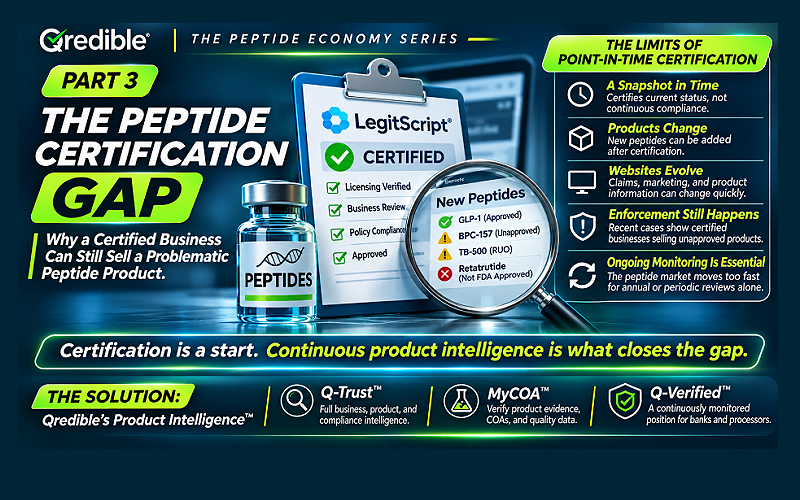
Certifying a business and verifying every product that business sells are not necessarily the same thing.
And neither automatically establishes that every future change to the business will remain compliant.
The question isn't whether certification has value.
It absolutely does.
The question is whether certification alone provides all the intelligence a financial institution needs to manage a rapidly changing merchant relationship.
This distinction is fundamental.
Consider a legitimate telehealth business.
Its clinicians may be appropriately licensed.
Its corporate structure may satisfy applicable requirements.
Its pharmacy relationships may have been reviewed.
Its website may meet a certification provider's standards.
But none of those facts independently establishes that every peptide product offered through the business is FDA-approved or otherwise lawful for its intended use.
The FDA approves specific drug products—not entire ecommerce businesses.
A pharmacy license does not authorize the pharmacy to dispense any substance it chooses.
A valid prescription does not make an otherwise impermissible compounded product lawful.
And a business certification does not convert an investigational peptide into an approved medication.
These distinctions become especially important when dealing with products such as:
Retatrutide: An investigational peptide that is not FDA-approved and that FDA has identified as ineligible for compounding under current federal law.
BPC-157: An unapproved peptide that has attracted significant commercial attention and has been the subject of FDA safety and compounding concerns.
TB-500: A peptide-related product category requiring careful assessment of the specific substance, intended use, and applicable regulatory requirements.
Other experimental peptides: Products marketed for recovery, longevity, weight management, or performance without FDA approval for those claimed therapeutic uses.
A merchant may be operating a legitimate business while introducing a product that creates a new and potentially serious regulatory issue.
That's why the product itself must become part of the ongoing compliance conversation.
The FDA has repeatedly taken action against businesses marketing unapproved peptide products.
In 2026, FDA warning letters involving online peptide sellers highlighted a recurring problem: products labeled for research use were being marketed in ways that indicated intended human use.
The FDA's March 2026 warning letter to Gram Peptides is one example.
The agency examined more than the research-use disclaimer. It considered the broader circumstances and representations surrounding the products.
That illustrates an important principle:
A disclaimer does not override the actual intended use established by a seller's marketing and conduct.
A website can display "Not for Human Consumption" while simultaneously presenting information that raises questions about whether the products are being promoted for human therapeutic purposes.
And for banks, that distinction can determine whether a merchant fits within the institution's policies.
What About Reports Involving Certified Businesses?
Recent reporting has also raised questions about businesses associated with recognized pharmacy certification programs while allegedly offering problematic peptide products.
Those reports deserve investigation.
However, establishing a certification failure requires more than identifying a merchant that displayed a certification seal.
A responsible assessment must establish:
Without those facts, it would be inappropriate to characterize an allegation as a proven certification failure.
The broader lesson remains valid regardless of the outcome of any individual case.
Certification programs, merchants, and financial institutions all need effective ways to detect material changes after an initial assessment.
Think about how most merchant relationships operate.
During onboarding, the business is subjected to significant scrutiny.
Documents are collected.
Licenses are reviewed.
Ownership is verified.
Products are evaluated.
Websites are examined.
Policies are checked.
The merchant is approved.
Then business continues.
And business changes.
New products are added.
Suppliers change.
Ingredients change.
Marketing claims evolve.
New sales channels are introduced.
The merchant expands into new states.
A telehealth company adds another pharmacy partner.
A research supplier introduces new peptide categories.
A website redesign changes how products are described.
Each of these changes can affect the merchant's regulatory and banking risk profile.
Yet traditional underwriting systems often remain focused on the information collected when the account was opened.
This is compliance drift.
It doesn't necessarily mean the merchant is acting dishonestly.
In many cases, the business simply doesn't recognize that an ordinary commercial decision can create a new regulatory or underwriting issue.
But the acquiring bank remains responsible for managing its merchant relationships under applicable law, network requirements, and institutional policies.
The merchant that was approved is not necessarily the merchant operating today.
Business certification may assess organizational credentials, operational standards, and defined compliance requirements.
Product verification asks different questions.
What exactly is being sold?
What is its regulatory classification?
Is it approved for the represented use?
Does the product require a prescription?
Is it eligible for compounding?
What evidence supports the product's identity and claims?
These questions cannot always be answered through business-level credentials alone.
A thorough initial review is essential.
But it reflects the information available during that review.
Even certification programs that conduct ongoing monitoring may have different scopes, intervals, and methods for identifying changes.
Financial institutions should understand those differences rather than assuming every product change is automatically detected.
A valid license establishes a particular authorization.
It does not independently verify every commercial activity conducted by the license holder.
For example, a licensed pharmacy may still face questions about specific compounded substances, sourcing arrangements, or marketing practices.
A certificate of analysis may help establish a product's identity, purity, or tested composition.
But it does not establish that the product is FDA-approved.
It does not prove that the product may lawfully be sold for human consumption.
And it does not establish that the merchant meets every acquiring bank's requirements.
A COA is evidence. It is not a regulatory permission slip.
An acquiring bank may approve a merchant based on its current business model.
That approval does not automatically extend to every new product, therapeutic claim, fulfillment arrangement, or business activity introduced later.
Sustainable bankability requires the merchant to remain aligned with applicable requirements as its business evolves.
Imagine a different operating environment.
A telehealth merchant has completed its licensing review and obtained an applicable third-party certification.
The acquiring bank has approved the merchant.
But instead of placing the documentation into a static underwriting file, the merchant maintains a structured, continuously monitored business and product profile.
When a new product appears on the website, the change is identified for review.
When marketing language changes, the new claims can be evaluated.
When a license approaches expiration, the merchant can be prompted to provide updated evidence.
When a new peptide is introduced, its regulatory status and supporting documentation can be investigated before the institution decides whether the activity remains acceptable.
When a compliance concern is identified, the merchant has a documented process for remediation.
And authorized financial partners can review relevant evidence without repeatedly requesting the same information.
This is the difference between collecting compliance documents and operating a continuous merchant intelligence program.
The objective is not to eliminate certification.
It's to make certification, product intelligence, and ongoing merchant monitoring work together.
At Qredible, we believe the future of merchant risk management requires an integrated approach to business and product intelligence.
That's the foundation of our Merchant Intelligence Operating System™.
Q-Trust™: Know the Business
Q-Trust brings together intelligence concerning business identity, ownership, licensing, products, website content, reputation, marketing, and other relevant risk indicators.
For peptide merchants, this can help identify potential concerns involving the business model, product catalog, and publicly observable commercial activities.
MyCOA®: Know the Product
MyCOA helps organize product-level information and associate products with supporting laboratory reports and other available evidence.
For peptide commerce, that means creating a more structured record of product identity, specifications, and relevant documentation.
Where the available evidence is insufficient to determine a product's legal status or intended use, the issue can be flagged for further verification.
Q-Registered™: Organize the Evidence
Q-Registered provides a structured framework for maintaining merchant and product information.
This can help reduce reliance on disconnected files, outdated spreadsheets, and repeated documentation requests.
Q-Verified™: Demonstrate Accountability
Q-Verified is designed to reflect defined verification requirements and ongoing monitoring expectations.
It can help participating merchants demonstrate a commitment to transparency and maintaining current information.
It is not an FDA approval, a substitute for LegitScript certification, or a guarantee of bank acceptance.
Continuous Monitoring: Detect the Changes
Perhaps the most important element is the ability to identify material changes after onboarding.
Product catalogs evolve.
Websites change.
Marketing claims change.
Business information changes.
And regulatory requirements change.
Continuous intelligence supports timely investigation and reassessment.
The goal is to give banks and processors better visibility into the merchant they support today—not merely the merchant they approved months ago.
I believe the industry needs to move away from treating different compliance solutions as mutually exclusive.
Licensing authorities have a role.
Certification and accreditation providers have a role.
Clinical and pharmacy regulators have a role.
Acquiring banks have a role.
And product intelligence platforms have a role.
The strongest merchant risk management model brings these capabilities together.
Consider the distinction:
| Compliance Capability | Primary Purpose |
| Professional licensing | Assesses a business against defined certification criteria |
| Product intelligence | Identifies and evaluates products and related information |
| Laboratory evidence | Supports specific product identity or quality assessments |
| Continuous monitoring | Detects relevant changes requiring reassessment |
| Bank underwriting | Determines merchant eligibility under institutional policies |
No single component should be mistaken for all the others.
The objective is a more complete and current understanding of the merchant.
And in rapidly evolving markets such as peptides, that understanding can change quickly.
For financial institutions, this isn't simply a discussion about compliance technology.
It's about the economics and sustainability of regulated commerce.
Without sufficient product-level visibility, banks may respond to uncertainty by restricting entire merchant categories.
That can exclude legitimate pharmacies, telehealth businesses, and research suppliers alongside businesses presenting unacceptable risk.
Alternatively, institutions may continue supporting merchants without recognizing material changes to their products or activities.
Neither outcome is ideal.
A more intelligence-driven approach creates the opportunity for:
Better underwriting: More complete information about the business and its products.
More targeted monitoring: Attention directed toward identified changes and potential issues.
Faster remediation: Clearer evidence of what requires correction.
Improved portfolio visibility: A more informed understanding of exposure across regulated merchant categories.
Greater merchant accountability: Better documentation of business practices and corrective actions.
More sustainable relationships: A framework that supports eligible merchants while identifying activities that may no longer be acceptable.
These benefits depend on accurate information, appropriate review procedures, and effective implementation. Technology alone cannot guarantee compliance outcomes.
If your institution supports online pharmacies, telehealth providers, peptide research suppliers, or related businesses, ask yourself:
Do we know which peptides our merchants are selling today?
Can we distinguish approved prescription medications from investigational products?
Can we identify when a merchant introduces a new peptide?
Can we evaluate whether its marketing suggests an unapproved therapeutic use?
Do we know when licenses, pharmacy relationships, or product documentation change?
Can we provide an auditable explanation of how material concerns were investigated and resolved?
And perhaps most importantly:
Are we relying on the merchant's original approval—or do we have current intelligence about what the merchant is actually doing?
Those are questions every acquiring bank should be prepared to answer.
The peptide industry is evolving rapidly.
New substances are being investigated.
New businesses are entering the market.
Telehealth models are expanding.
Research suppliers are attracting attention.
And regulatory policy continues to develop.
In this environment, a one-time review—even a rigorous one—cannot establish that a business will remain unchanged.
That doesn't diminish the value of certification.
It demonstrates why certification should be part of a broader system of ongoing intelligence, evidence management, and risk oversight.
The future of regulated commerce will not be built on who can display the most certification badges.
It will be built on who can demonstrate what they sell, why they are authorized to sell it, and how they remain accountable when things change.
At Qredible, that's the future we're working to enable.
Coming Next: Part 4 — Peptides & Payments
Why the Last Step of Commerce May Be the Hardest
We'll explore what peptide businesses need to obtain banking and merchant accounts, how financial institutions evaluate prescription and research-use-only models, and where credit cards, ACH, pay-by-bank, and cryptocurrency fit.
We'll also examine why payment redundancy is essential—and why having multiple processors doesn't solve a fundamentally unbankable business model.
Connect With Qredible
If you're an acquiring bank, payment processor, ISO, online pharmacy, telehealth provider, or legitimate research supplier, we'd welcome the opportunity to show you how Q-Trust™, MyCOA®, and Q-Verified™ can support stronger merchant intelligence and ongoing compliance readiness.
Know Before They Ask™.
Qredible | The Trust Layer for Regulated Commerce
Regulatory note: This article is educational and does not constitute legal or medical advice. Certification requirements, drug classification, product eligibility, and financial institution policies vary. Qredible supports intelligence, evidence management, and monitoring; it does not independently guarantee regulatory compliance or merchant approval.
Qredible is redefining merchant underwriting through Merchant Risk Intelligence (MRI)—a product-first approach that continuously analyzes what businesses sell, how they market those products, and the evidence required to support compliant payment acceptance. By moving beyond static industry classifications, Qredible helps banks, payment processors, ISOs, and sponsor banks make faster, more informed, and more defensible underwriting decisions while reducing manual effort and strengthening ongoing portfolio oversight. Learn more about Qredible's product-first automated compliance management platform for regulated industries →