The Future of Peptide Commerce: Where Science, Regulation, AI, and Financial Infrastructure Converge
The Future of Peptide Commerce: Where Science, Regulation, AI, and Financial Infrastructure Converge The Peptide Economy — Part 6 of 6...
 Imagine you've spent a year building a peptide business.
You've invested in product development, suppliers, a website, marketing, customer acquisition, and fulfillment.
Your products are generating interest.
Your customer pipeline is growing.
And then you discover something that threatens the entire operation.
You can't find a bank or payment processor willing to support your business.
Or worse, you find one, begin processing, and several months later receive a notice that your account is being terminated.
Suddenly, the question isn't whether customers want your products.
It's whether you can actually accept their money.
This is one of the most overlooked challenges in the rapidly expanding peptide economy.
And after more than 30 years in payments, I can tell you that it's not unique to peptides.
I've watched the same pattern unfold across CBD, hemp, vape, nutraceuticals, telehealth, and other regulated industries.
Innovation creates demand.
Entrepreneurs build businesses.
Payment providers see opportunity.
But the financial institutions responsible for supporting those transactions often struggle to distinguish legitimate operators from businesses creating unacceptable regulatory exposure.
And when banks can't confidently understand the risk, they frequently choose not to take it.
In Parts 1 through 3 of The Peptide Economy, we explored the science, the commercial models, and the limitations of relying exclusively on business-level certifications.
Now we're examining the final step of commerce.
Getting paid.
Let's establish something important.
Peptides are not inherently illegal.
Many peptide-based medications are FDA-approved and prescribed every day.
Legitimate research laboratories purchase peptide materials for scientific purposes.
Licensed pharmacies, medical practices, and appropriately structured telehealth businesses participate in lawful peptide-related commerce.
But the term peptide business covers an enormous range of activities.
Consider four examples.
Merchant A: A licensed pharmacy dispensing FDA-approved prescription peptide medications.
Merchant B: A telehealth business coordinating clinical consultations and lawful prescription fulfillment through licensed professionals and pharmacies.
Merchant C: A research supplier selling peptide reagents for legitimate laboratory applications.
Merchant D: An ecommerce website selling unapproved injectable peptides directly to consumers while promoting therapeutic benefits.
All four may apply for payment processing under descriptions such as healthcare, wellness, biotechnology, or research supplies.
But they represent dramatically different regulatory and underwriting profiles.
A bank needs to understand the actual business model.
What products are being sold?
Are they FDA-approved medications, lawfully compounded preparations, or legitimate research materials?
Who is purchasing them?
Who manufactures and fulfills them?
What licenses are required?
What claims are being made?
And does the institution's policy permit the activity?
The problem isn't necessarily the industry. It's the inability to distinguish acceptable business models and products from unacceptable ones.
That's where Product Intelligence™ becomes essential.
One of the first mistakes entrepreneurs make is assuming that opening a business checking account means they can accept payments for any products they choose to sell.
These are different financial relationships.
Business Banking
A commercial deposit account allows a business to receive and hold funds, pay expenses, and manage its financial operations.
Banks conduct customer identification, due diligence, and other reviews under applicable laws and their internal policies.
They may also evaluate the nature of the business and its products.
A bank's willingness to open a deposit account does not establish that it will support card acquiring or other payment acceptance services.
Merchant Processing
A merchant account or payment acceptance relationship allows a business to accept transactions through payment networks or other processing systems.
For card payments, this generally involves an acquiring bank, payment processor, payment facilitator or ISO, and the relevant card networks.
The acquiring institution evaluates merchant eligibility, transaction risk, chargebacks, refunds, regulatory exposure, and compliance with its own policies and network requirements.
A business can qualify for a checking account and still be declined for card processing.
And a payment facilitator or ISO may advertise support for a particular industry while its sponsor bank retains the authority to restrict that activity.
This is why understanding the financial institution behind the processing relationship matters.
When evaluating a peptide merchant, a responsible acquiring bank needs more than a completed application and a website URL.
The specific requirements vary, but a strong underwriting package typically addresses five areas.
Business Identity & Ownership
Legal entity information, DBA, operating address, beneficial ownership, management, business history, and relevant organizational records.
Regulatory & Licensing
Professional licenses, pharmacy registrations, state authorizations, and other documentation appropriate to the business model.
For telehealth, this may include understanding the relationships among the technology platform, medical practice, clinicians, and dispensing pharmacy.
Product Eligibility
A complete understanding of the products being sold.
For prescription medications, that includes relevant approval status, sourcing, dispensing, and prescribing arrangements.
For compounded preparations, the institution may need evidence supporting the applicable compounding pathway.
For research suppliers, the bank may examine intended use, customer qualification, product descriptions, and marketing practices.
Financial & Processing History
Expected monthly volume, average transaction amount, sales channels, refund policies, fulfillment practices, processing statements where available, chargeback history, and financial information.
Compliance & Risk Controls
Website policies, customer verification procedures, advertising practices, complaint handling, fulfillment controls, and ongoing monitoring processes.
The stronger and more transparent the application, the easier it is for an underwriter to understand the actual risk.
But no amount of documentation can make a prohibited product eligible under a bank's policies.
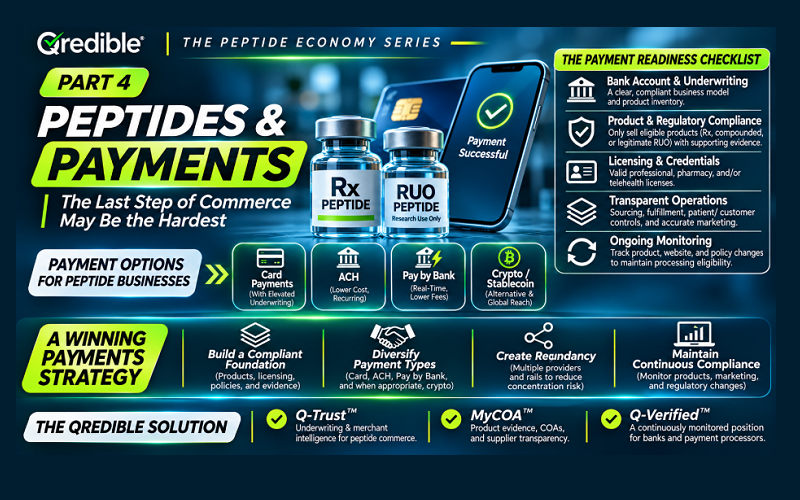
Card payments remain a preferred payment method for many ecommerce consumers because they're familiar, convenient, and widely accepted.
But for peptide businesses, card acceptance can be challenging.
An acquiring bank may require enhanced due diligence, specialized underwriting, reserves, processing limits, or additional monitoring.
Certain products or business models may be prohibited outright.
Card networks also have rules concerning illegal transactions and regulated merchant activity.
And the acquiring bank remains responsible for the merchants it sponsors.
Chargebacks: Customers may dispute transactions because of fulfillment issues, subscription misunderstandings, product expectations, or other concerns.
Regulatory exposure: The merchant may introduce products or marketing claims that conflict with applicable law or bank policy.
Account restrictions: Processing limits, rolling reserves, or settlement delays may affect cash flow.
Termination: Material policy violations or changes in the institution's risk appetite can result in loss of processing services.
Legitimate peptide businesses with transparent operations, appropriate licensing, documented products, and strong compliance controls may be better positioned for underwriting consideration.
But the goal should never be to find a processor willing to overlook the business model.
It should be to find an institution whose policies genuinely support the merchant's lawful activities.
ACH payments allow funds to move between bank accounts through the Automated Clearing House network.
For eligible businesses, ACH can support recurring payments, invoice collections, and other commercial transactions.
It may offer different economics and operational characteristics from card payments.
But ACH has its own rules, authorization requirements, return risks, and underwriting considerations.
Merchants must obtain appropriate authorization.
They need processes for managing returns, disputes, and unauthorized transactions.
They must comply with applicable Nacha rules and their financial institution's requirements.
And their underlying business activity must be acceptable to the institutions involved.
Switching from cards to ACH does not make an unlawful product lawful.
Nor does it guarantee that a bank will support the merchant.
For legitimate peptide businesses, ACH can be a useful component of a diversified payment strategy.
It is not a substitute for compliance.
Pay-by-bank solutions allow customers to authorize payments directly from bank accounts through supported payment technologies.
Depending on the provider, the underlying rails may include ACH or other bank payment systems.
Some offerings incorporate account verification, bank authentication, and improved payment experiences.
For eligible merchants, pay-by-bank may provide benefits such as:
However, not every pay-by-bank solution offers the same capabilities, settlement timing, dispute protections, or merchant eligibility.
And providers still apply underwriting and risk policies.
The critical question isn't simply whether pay-by-bank is available. It's whether the provider and its financial partners explicitly support the merchant's actual products and business model.
For peptide businesses, that distinction is essential.
Cryptocurrency and stablecoins are increasingly discussed as alternatives to traditional payment methods.
Some merchants see them as a way to reduce dependence on banks and card networks.
But the regulatory and operational questions don't disappear simply because the payment instrument changes.
Businesses must consider:
Legal eligibility: The underlying sale must still be lawful.
Financial regulation: Depending on the parties and activities, money transmission, sanctions, anti-money-laundering, and other requirements may apply.
Custody and conversion: The merchant needs to understand how funds are received, held, converted, and transferred.
Accounting and taxation: Digital asset transactions can create recordkeeping and tax considerations.
Customer experience: Not every consumer wants to pay with digital assets.
Operational risk: Wallet security, transaction irreversibility, fraud, and provider reliability require appropriate controls.
Stablecoins may reduce certain price-volatility concerns relative to other cryptocurrencies, but they introduce their own issuer, redemption, custody, and counterparty risks.
Crypto is not a compliance escape hatch.
It can be another payment option for an eligible business, subject to applicable laws and provider requirements.
Now let's talk about business continuity.
Imagine a peptide merchant processing $500,000 per month.
Its entire business depends on one acquiring bank and one payment processor.
That institution changes its risk appetite.
The merchant receives notice that processing will be discontinued.
Suddenly, the business has a serious operational problem.
This is why I believe payment redundancy deserves greater attention.
But redundancy has two distinct dimensions.
Maintaining more than one appropriately approved payment relationship can reduce dependence on a single institution.
That may include separate acquiring banks or providers with genuinely independent sponsorship arrangements.
Two processors relying on the same sponsor bank may not provide meaningful institutional redundancy.
Supporting more than one payment method can provide customers with alternatives.
For example, an eligible business may offer card payments and bank-based payments.
However, diversification only works when the underlying business is acceptable to each participating provider.
It should not involve hiding products from an underwriter.
It should not involve misrepresenting the business category.
It should not involve routing prohibited transactions through an unrelated merchant account.
And it should not involve moving transactions between providers to evade monitoring or account restrictions.
Payment redundancy is a business continuity strategy—not a strategy for avoiding regulatory or banking requirements.
Here's where I believe the payments industry needs to change its thinking.
Too many merchants view payment processing as a one-time challenge.
Find a processor.
Get approved.
Start accepting payments.
Move on.
But peptide businesses operate in a dynamic regulatory environment.
Products change.
New formulations appear.
Marketing claims evolve.
Clinical relationships change.
Suppliers change.
State and federal requirements evolve.
And acquiring banks update their policies.
A merchant approved today may not remain eligible tomorrow if its business materially changes.
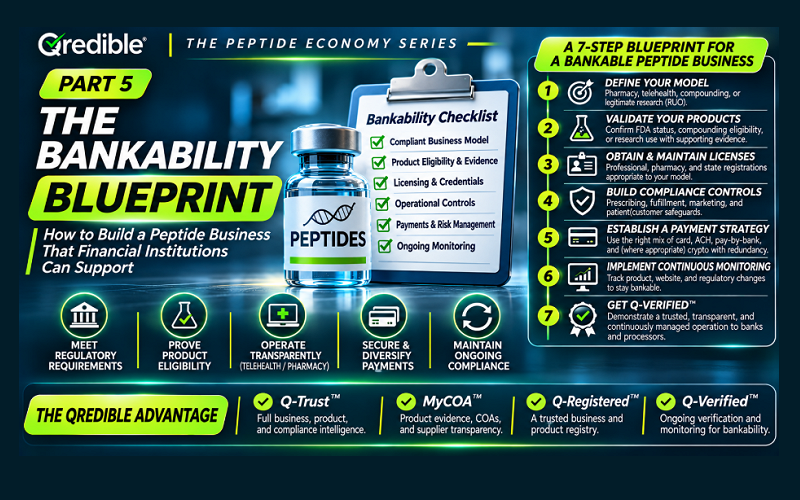
That's why bankability must become an ongoing operating discipline.
A sustainable peptide business should be able to demonstrate:
The bank shouldn't have to reconstruct the merchant's business every time it conducts a review.
And the merchant shouldn't wait for an emergency documentation request to organize its records.
At Qredible, we believe the future of regulated merchant underwriting is built on continuous intelligence.
Not simply collecting more documents.
Not simply assigning an industry risk category.
But understanding the business and its products at a level that supports more precise financial decisions.
Q-Trust helps assess business identity, ownership, licensing, website content, products, marketing, reputation, and other relevant indicators.
This gives acquiring banks and payment organizations a more structured foundation for evaluating peptide merchants.
Before a merchant applies for processing, Qredible's Merchant Risk Intelligence Report can help identify potential underwriting concerns and documentation gaps.
After corrective actions, an updated report can support a more complete submission.
This can help reduce avoidable surprises during underwriting.
MyCOA helps maintain structured product records and supporting laboratory evidence where relevant.
For peptide merchants, product identity, specifications, sourcing, and available quality documentation can be important parts of the assessment.
A COA does not establish FDA approval or independently prove that a product is lawful for human use.
These capabilities are designed to help merchants organize relevant information and demonstrate defined verification and monitoring practices.
They support transparency and ongoing accountability.
They do not guarantee regulatory compliance, processing approval, or acceptance by any particular bank.
When a merchant adds a new peptide, changes marketing language, or modifies other monitored information, those changes may create new questions for the financial institution.
Continuous intelligence supports earlier identification and review.
The objective is simple: Make the merchant easier to understand, easier to evaluate, and better prepared for ongoing banking relationships.
If I were advising a legitimate peptide business entering the market today, I'd recommend a disciplined sequence.
Before pursuing payment processing, determine whether the business model and products are lawful.
Obtain appropriate regulatory and legal guidance.
Verify the necessary licenses, prescribing or research controls, sourcing, and product documentation.
Use Q-Trust to identify potential business, product, website, licensing, and marketing issues.
Address material concerns before submitting applications.
Seek banks and payment providers whose documented policies support the specific business model and product categories.
Don't rely solely on a sales representative's verbal assurance.
Provide accurate business information, ownership details, financials, processing history, product documentation, licensing, and relevant compliance controls.
Include an updated Merchant Risk Intelligence Report to support the assessment.
Evaluate cards, ACH, pay-by-bank, and other methods based on customer needs, costs, operational requirements, and provider eligibility.
Where commercially practical, maintain additional approved payment relationships that reduce concentration risk.
Understand the underlying sponsor-bank relationships.
Maintain current product information, licenses, website disclosures, and supporting evidence.
Review material changes before they create unexpected processing issues.
The strongest payments strategy starts long before the first transaction.
If your organization supports peptide-related commerce, consider these questions.
Can you distinguish a legitimate research supplier from a consumer-facing seller of unapproved therapeutic products?
Can you verify the products actually being offered?
Do you understand the relationships among telehealth platforms, medical practices, and dispensing pharmacies?
Can you identify material changes after onboarding?
Do your merchants have the documentation needed to support continued eligibility?
And can your organization help legitimate operators become more transparent and bankable rather than simply searching for the next processor willing to accept them?
The opportunity isn't just to process peptide transactions. It's to build the financial infrastructure that legitimate peptide commerce requires.
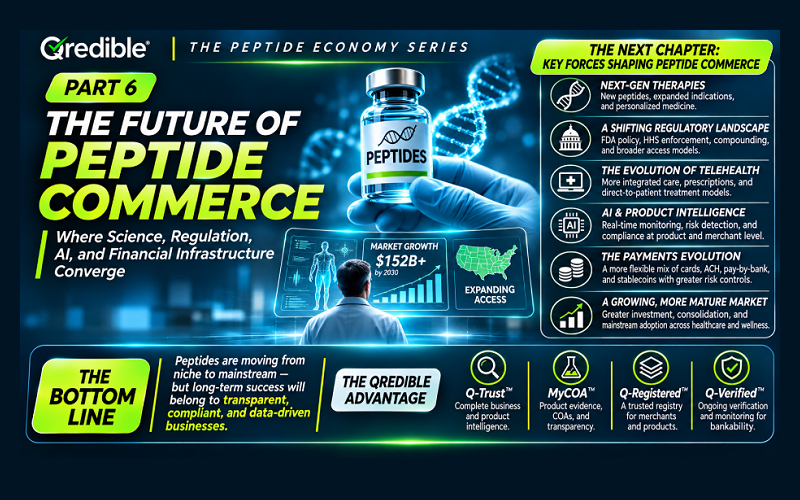
The peptide economy is creating meaningful opportunities across healthcare, biotechnology, research, and financial services.
But the ability to accept a payment should never be mistaken for proof that the underlying product or business is legitimate.
A payment gateway doesn't establish FDA approval.
An ACH transaction doesn't establish lawful research use.
A stablecoin doesn't eliminate regulatory obligations.
And a merchant account doesn't mean every future product will remain acceptable.
The future of peptide payments will belong to businesses that can demonstrate why they are eligible to participate—and to financial institutions with the intelligence to recognize the difference.
That's the opportunity Qredible is working to enable.
Coming Next: Part 5 — The Bankability Blueprint
How to Build a Peptide Business That Financial Institutions Can Support
We'll move from understanding the market to building the operating model: product validation, licensing, documentation, underwriting preparation, Q-Verified readiness, and continuous compliance management.
Connect With Qredible
If you're a peptide merchant, telehealth provider, research supplier, acquiring bank, ISO, or payment processor, connect with Qredible to explore how Q-Trust™, MyCOA™, and Merchant Risk Intelligence can support stronger underwriting preparation and more sustainable payment relationships.
Know Before They Ask™.
Qredible | The Trust Layer for Regulated Commerce
Educational notice: This article provides general information and does not constitute legal, financial, or medical advice. Payment acceptance, product eligibility, licensing, and underwriting requirements depend on the business model, applicable laws, payment network rules, and individual financial institution policies.
Qredible is redefining merchant underwriting through Merchant Risk Intelligence (MRI)—a product-first approach that continuously analyzes what businesses sell, how they market those products, and the evidence required to support compliant payment acceptance. By moving beyond static industry classifications, Qredible helps banks, payment processors, ISOs, and sponsor banks make faster, more informed, and more defensible underwriting decisions while reducing manual effort and strengthening ongoing portfolio oversight. Learn more about Qredible's product-first automated compliance management platform for regulated industries →